
AI Automation Platforms for D2C Brands Compared, Job by Job
Which AI automation platforms D2C brands use for support, email and SMS, ops, catalogue and agentic commerce, what each costs, and when custom builds win.
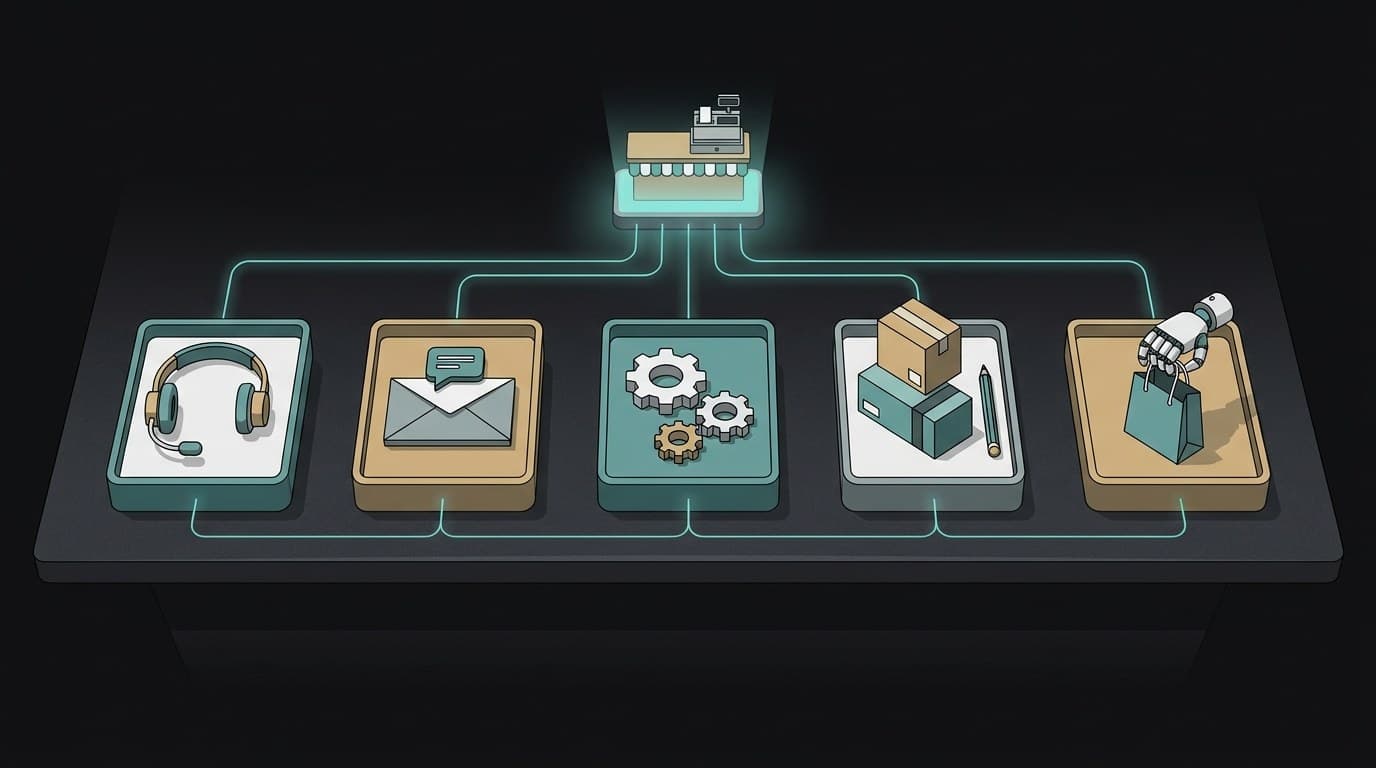
The best AI automation platforms for D2C brands depend on the job. For support, Gorgias and Klaviyo Customer Agent lead on Shopify stores. For email and SMS, Klaviyo. For operations, Shopify Flow first, then Zapier, Make or n8n when you need apps outside Shopify. For catalogue copy, Shopify Sidekick. For AI shopping agents, Shopify agentic storefronts. Custom builds make sense only where these tools stop.
If you want ideas like these working inside your own business, see our AI development and automation service.
Prices below come from official pricing pages as of November 2026.
Every tool below reads your product data, order data and policies. If those are messy, the AI will be confidently wrong, so read what D2C brands need to fix before adding AI first.
How should a D2C brand compare AI automation platforms?
Compare them by the job you want done, not by the AI label on the homepage. Almost every ecommerce tool now ships an "agent", so the label tells you nothing. We use five jobs:
Customer support: answering "where is my order", returns, exchanges, product questions.
Email and SMS marketing: flows, campaigns, segmentation, copy.
Operations and workflow: tagging orders, inventory alerts, fraud holds, syncing data between apps.
Catalogue and content: product descriptions, images, collections, SEO copy.
Agentic commerce readiness: whether AI shopping agents in ChatGPT, Gemini or Copilot can find and buy your products.
For each job, ask: can it read the data it needs, can it act (refund, edit an order) or only draft, and how is it billed? The billing unit matters more than the headline price, because it decides your bill when volume doubles in a sale week.
Which AI platforms handle customer support for D2C brands?
For most Shopify brands the real choice is between Gorgias and Klaviyo Customer Agent, with the decision usually made by which of the two you already pay for.
Gorgias
Gorgias is a helpdesk built for ecommerce, with an AI Agent that sells and supports across chat and email and integrates with Shopify and BigCommerce. It pulls order data into each ticket, so a human or the AI can see the order, cancel it or issue a refund without switching tabs.
Pricing, per the Gorgias pricing page as of November 2026: the Starter helpdesk is $10 a month billed monthly, with 50 tickets included and $0.40 per extra ticket. The AI Agent is billed per automated interaction, which Gorgias defines as "a customer request that's fully resolved without a human agent". AI Agent interactions are listed at $0.90 each on annual plans and $1.00 on monthly plans, with $1.50 per interaction above your plan's allowance.
That model is fair, but run the numbers against what a human agent costs per ticket today.
Klaviyo Customer Agent
Klaviyo Customer Agent is an AI support agent built on Klaviyo's customer data. According to Klaviyo's help center, it works across web chat, email, SMS and WhatsApp, and can answer product and brand questions, recommend products, track and edit orders, process returns and exchanges, manage subscriptions and loyalty, and hand off to a human.
Its edge is context: it sits on the same profiles your marketing uses. If you are not on Klaviyo, it is not for you.
How to pick between them
Already on Gorgias with a trained team and macros: add its AI Agent and measure resolution rate for a month.
Already on Klaviyo and support volume is mostly simple: test Customer Agent before buying a separate helpdesk.
What is the best AI automation for D2C email and SMS marketing?
Klaviyo is the default for Shopify D2C brands, and its AI is built into the product rather than sold as a separate tool. Klaviyo describes its AI layer, K:AI, as including a Marketing Agent that can turn a website URL into a marketing plan and draft on brand campaigns, alongside AI features such as a subject line generator.
Per the Klaviyo pricing page as of November 2026, the free plan covers up to 250 profiles and 500 emails a month, plus $5 of mobile messages a month. Paid prices are set by the calculator on that page, so check them with your own profile count.
AI drafting is the easy part. Segmentation and timing move revenue, and they depend on clean event data from your store.
Which platforms automate D2C operations and workflows?
Start with Shopify Flow, because it is free and runs inside Shopify, then reach for Zapier, Make or n8n only when the workflow has to leave Shopify.
Shopify Flow
Shopify Flow is Shopify's own automation app. It watches your store for events and runs a sequence of actions using triggers, conditions and actions. Typical uses are tagging high value orders, holding risky orders for review, alerting the team when stock runs low, or hiding sold out products. You install it free from the Shopify App Store.
Shopify's help center page on Sidekick says Sidekick "can build Shopify Flow workflows that do repeated work for you", which means a non technical operator can describe a rule in plain words and get a draft workflow to review.
Zapier
Zapier connects thousands of apps with no code "Zaps". It suits teams that want something working this afternoon. Per the Zapier pricing page as of November 2026, the free plan includes 100 tasks a month on two step Zaps, and the Professional plan starts from $19.99 a month. Zapier meters by task, meaning each action a Zap performs. Copilot, its AI assistant for building Zaps, is on every plan, with a daily message limit on the free tier.
Make
Make is a visual scenario builder with more control over branching and data shaping than Zapier, at a lower entry price. Per the Make pricing page as of November 2026, the free plan gives 1,000 credits a month and two active scenarios, and the Core plan starts at $9 a month. Each module action costs one credit. All plans include Make AI Agents (in beta), an MCP server and an AI toolkit. MCP, the Model Context Protocol, is a standard way for an AI assistant to call outside tools.
n8n
n8n is a workflow tool that you can run on n8n's cloud or host yourself. Per the n8n pricing page as of November 2026, the cloud Starter plan is $20 a month billed annually for 2,500 workflow executions, and a standard self hosted community edition is available on GitHub. n8n counts executions, not steps, so a long workflow costs the same as a short one. Its AI Agent node, MCP client and server, and human approval for tool calls make it the most developer friendly of the three.
A quick rule for ops tools
Everything happens inside Shopify: Shopify Flow.
A few apps, low volume, nobody technical on the team: Zapier.
Branching logic, data transformation, cost sensitive: Make.
High volume, many steps per run, someone who can read JSON, or data you want kept on your own servers: n8n.
Which AI tools help with catalogue and product content?
For Shopify brands, Sidekick inside the admin is the first stop for product content. Shopify says Sidekick can create content such as product descriptions and images, edit orders, and generate custom apps, and it presents changes for your review before applying them. It can also write and run its own code to forecast or summarise store data.
With thousands of SKUs, several languages or a separate product information system, teams usually run a batch workflow in Make or n8n that sends products to a language model with style rules and writes drafts back for review. Keep structured attributes (fabric, dimensions, care) as the source the AI must quote from, because invented claims cause returns.
How do D2C brands get ready for agentic commerce?
Agentic commerce means AI assistants that search for and buy products on a shopper's behalf, and on Shopify the starting point is agentic storefronts. According to the Shopify Help Center, agentic storefronts let customers discover and buy your products in AI channels such as ChatGPT, Google AI Mode and Gemini, Microsoft Copilot and Meta, and the feature is active by default for eligible stores.
On ChatGPT the purchase finishes on your own checkout; on Google AI Mode and Gemini, Copilot and Meta, shoppers can buy inside the channel if direct checkout is on. A knowledge base holds your returns and shipping policies so agents can answer questions.
Being switched on is not the same as being picked. Agents choose products whose data is complete and consistent, so the same catalogue hygiene from the content section applies. Many brands also block AI crawlers by accident in robots.txt; our guide on how stores block AI shopping agents without meaning to shows how to check. If you sell outside Shopify or want to understand the plumbing, read which agentic commerce protocol your store needs: UCP, ACP, AP2 or MCP. And you can run your store through the free agentic commerce checker to see whether AI shopping agents can find and buy from it.
When does off the shelf stop being enough?
Off the shelf stops being enough when the job crosses systems the tool cannot see, when the per task or per resolution bill grows faster than the value, or when the logic is specific to your business and no vendor will build it.
Concrete signals we look for:
The answer lives in three systems. A "where is my order" question needs Shopify, the warehouse system and the courier. If no support tool integrates all three, the AI guesses.
Your rules are unusual. Subscription swaps with custom proration, made to order lead times, bundles assembled at pick time. Generic agents handle generic policies.
Metered cost beats a fixed build. If you pay per automated interaction or per task and volume is high and steady, a purpose built service can cost less over a year.
You need an audit trail. Refunds above a threshold, discount approvals and fraud decisions need logging and human sign off that many tools only partly offer.
A worked example. A brand doing 4,000 support conversations a month finds 60 percent are order status questions, but its stock and dispatch data sits in a separate warehouse platform that its helpdesk cannot read. Keep the helpdesk and build one small service that answers order status from all three sources and exposes it to the helpdesk AI as a custom action. Off the shelf for everything else, custom for the one part that is unique to the brand.
That hybrid is what we see most often when we build these at AISmith. The full decision framework, including total cost of ownership and lock in, is in our guide on when custom AI solutions beat off the shelf SaaS. If you reach that point, our AI agents and automation service covers the custom pieces.
Key takeaways
Choose platforms by job (support, email and SMS, ops, content, agentic commerce), not by the AI label.
The billing unit (task, credit, execution, resolved interaction) decides your cost at scale more than the starting price.
Shopify Flow is free and should be the first ops tool for Shopify brands; Zapier, Make and n8n come in when work leaves Shopify.
Gorgias and Klaviyo Customer Agent both bill AI support by usage, so model it against your current cost per ticket.
Agentic storefronts are on by default for eligible Shopify stores, but clean product data decides whether agents pick you.
Build custom only for the cross system or business specific slice, and keep the off the shelf tools for the rest.
Frequently asked questions
What is the cheapest AI automation platform for a small D2C brand?
Shopify Flow costs nothing for Shopify stores and covers most in store automation. For work across other apps, Make starts at $9 a month and Zapier and Make both have free tiers, as of November 2026. The cheapest option is the one that does the job without forcing a second tool.
Should I use Gorgias or Klaviyo for AI customer support?
Pick the one that already holds your support history and customer data. Gorgias is a full ecommerce helpdesk with an AI Agent added; Klaviyo Customer Agent works from your marketing profiles and runs across chat, email, SMS and WhatsApp. Test either on your top three ticket types for a month before committing.
What is an AI audit for a D2C brand?
An AI audit checks whether your data, systems and processes are ready for automation before you buy tools. It usually covers product data quality, order and returns data, which tasks eat the most staff hours, and whether AI crawlers can reach your store. Our guide to AI prerequisites for D2C brands walks through the same checklist.
Do I need custom AI if I already use Shopify apps?
Usually not at first. Custom work pays off when a job depends on systems your apps cannot connect, when usage fees outgrow the value, or when your business rules are unusual. Start with the tools above and build only the gap.
Related reading
- AI for D2C Brands: What You Actually Need to Fix FirstAre you terrified your e-commerce business will become obsolete if you don't adopt artificial intelligence immediately? You aren't alone, but the relentless hype is misleading. Rushing into AI for D2C brands without a solid operational foundation won't fix your leaks—it will only scale your inefficiencies. In fact, companies that skip basic data hygiene waste up to 40% of their tech investments. Before you sign another software contract, you must master your data plumbing, unit economics, and standard operating procedures. Discover the exact foundational steps required to turn AI from a costly distraction into a massive profitability engine.
- Build vs. Buy: When Custom AI Solutions Beat Off-the-Shelf SaaSIs your company facing the "Build vs. Buy" dilemma for AI integration? While off-the-shelf SaaS offers speed, it often creates a ceiling for innovation. Discover the critical scenarios where investing in a custom AI solution forged specifically for your business yields a far greater return on investment and a sustainable competitive edge.
- Agentic commerce in 2026: what the numbers actually sayAI referred traffic to US retail grew 393 percent in a year and now converts better than every other channel. The pages doing the selling are the least readable ones on the site.
AISmith Team
Author