
What is DOM in Web Development? Why AI Agents Need It
Discover what is DOM in web development and why the Document Object Model is the secret engine powering modern AI browser automation and web scraping agents.
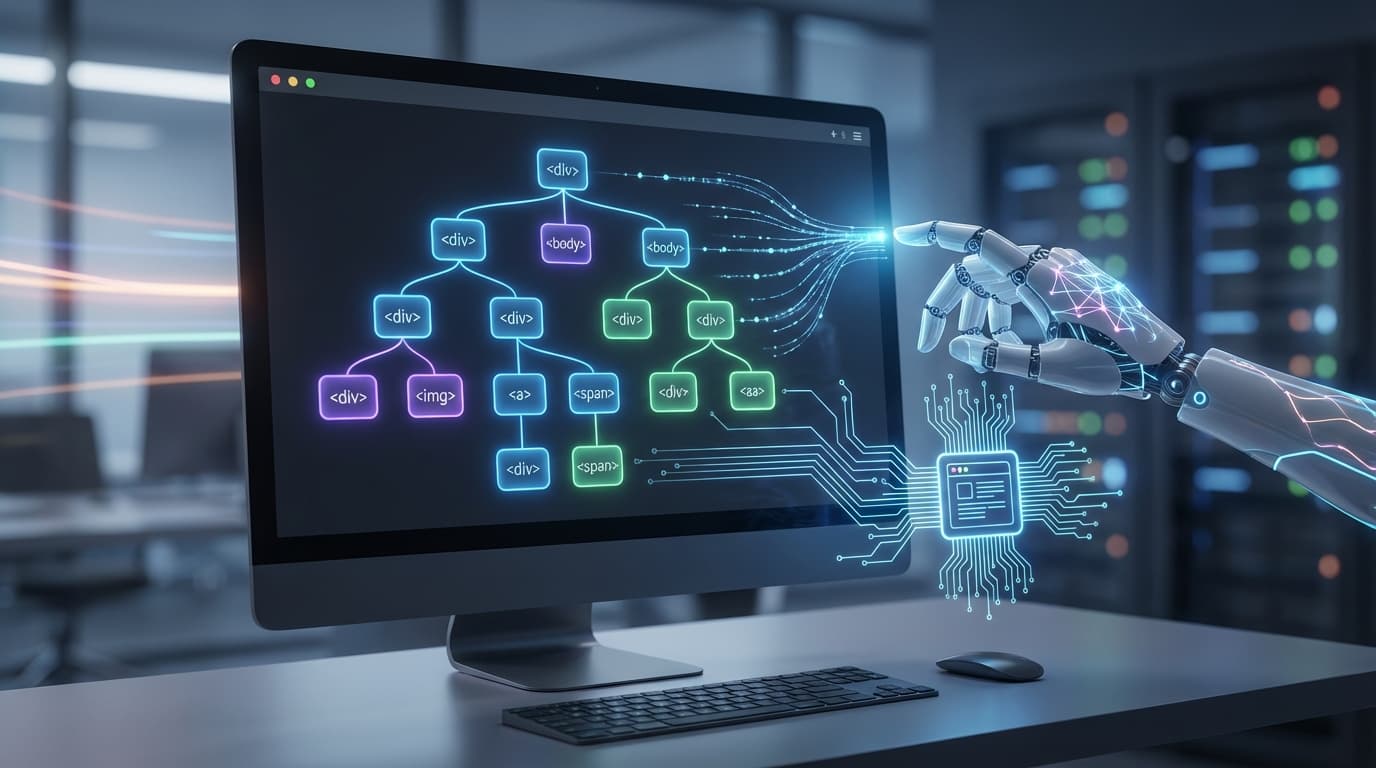
Every time you open a webpage, a complex and hidden structure comes to life behind the scenes. If you have ever wondered what is DOM in web development, you are certainly not alone. For years, the Document Object Model (DOM) was a niche concept reserved strictly for front-end engineers building interactive websites.
But the landscape of technology is shifting rapidly. Today, the DOM is no longer just a tool for human-facing web design. It has become the foundational sensory input for a massive technological revolution: AI browser automation agents.
From booking flights to scraping complex datasets, AI agents are autonomously navigating the web with incredible precision. But how do they actually "see" a webpage? The secret lies entirely in the DOM. Let's explore why this structural blueprint is the heartbeat of the modern web and the unsung hero of artificial intelligence.
Understanding the Basics: What is the DOM in Web Development?
At its absolute core, the Document Object Model (DOM) is a programming interface for web documents. When you type a URL into your browser, the server sends back a standard HTML document. HTML is essentially a static architectural blueprint.
It is a simple text file filled with structural tags like divs, paragraphs, and buttons. However, your browser does not just display raw text on the screen. It takes this static HTML blueprint and parses it into a living, breathing, hierarchical structure.
Think of HTML as the architectural blueprint of a house, and the DOM as the physical, fully furnished house itself where objects can be moved around in real-time.
Every single element, attribute, and piece of text in your HTML file becomes a "node" in the DOM tree. Because these nodes are treated as objects, they possess specific properties and methods. This object-oriented approach means they can be manipulated, styled, or deleted dynamically using JavaScript.
Why the Document Object Model is the Heartbeat of the Web
For modern software engineers, mastering the DOM in web development is the bridge between static content and highly interactive user experiences. Before the invention of modern JavaScript, web pages were entirely static. If you wanted to see new content, you had to refresh the entire page and request a brand new HTML file from the server.
Today, thanks to the DOM API, JavaScript can dynamically listen to user events like mouse clicks, scrolls, or keystrokes. It can fetch new data from a server in the background and inject it directly into the screen without ever reloading the page. When you "like" a post on social media and the heart icon instantly turns red, you are witnessing a direct DOM manipulation.
Modern JavaScript frameworks like React and Vue took this a step further by introducing the Virtual DOM. The Virtual DOM is a lightweight, in-memory copy of the actual DOM. Instead of making slow, direct changes to the real DOM every time a user interacts with a page, these frameworks calculate the necessary updates in the Virtual DOM first.
They then efficiently batch-update the real DOM all at once. This clever innovation is exactly what makes modern Single Page Applications (SPAs) feel lightning-fast and incredibly seamless to use.
The Evolution of AI Browser Automation
For years, browser automation meant writing highly specific, rigid scripts using testing tools like Selenium, Puppeteer, or Playwright. Developers had to write code telling the browser exactly what to do step-by-step. A classic web scraping script might say: "Find the button with the specific CSS class name and click it."
The massive problem with this approach is that the modern web is incredibly dynamic and messy. If a designer changed the button's class name, or if an A/B test altered the page layout, the automation script would instantly break. Traditional web scraping was notoriously brittle because it relied on hardcoded paths to specific DOM elements.
Enter the AI browser agents of the modern era. Frameworks like Browser-Use and Stagehand, powered by Large Language Models (LLMs) like GPT-4o or Claude 3.5 Sonnet, operate entirely differently. Instead of relying on rigid CSS selectors, these modern AI agents are given high-level goals in natural human language.
You simply tell the agent, "Log into my CRM, find the latest inbound leads, and export them to a spreadsheet." To accomplish this securely and accurately, the agent must understand the webpage exactly like a human operator would.
Why AI Browser Agents Rely on the DOM
You might be wondering why modern multimodal LLMs do not just look at screenshots of the webpage to navigate. While visual grounding is a popular technique, relying purely on pixels is highly inefficient and prone to AI hallucinations. Here is why the DOM remains the absolute source of truth for AI browser agents.
Semantic Understanding: An image tells an AI what a page looks like, but the DOM tells the AI what the page actually means. Parsing the DOM reveals whether a visual element is genuinely an interactable button or just styled text.
Exact Programmatic Targeting: When an AI relies solely on computer vision, it has to guess the exact X and Y coordinates to click. By using the DOM, the agent interacts directly with the programmatic node, ensuring a 100% accurate action.
Real-Time State Observation: Websites today load asynchronously. AI agents can actively monitor DOM mutations, knowing the exact millisecond a loading spinner is removed and the data is ready to be scraped.
Overcoming Challenges: DOM Downsampling and Token Limits
Despite its incredible power, feeding the DOM to an AI presents a massive technical hurdle. One of the biggest challenges in AI web automation has been the sheer size of modern HTML structures. A complex webpage like Amazon or Facebook can easily contain tens of thousands of individual DOM nodes.
Feeding this massive structure into an LLM would instantly overwhelm its context window and cost an absolute fortune in API tokens. To solve this bottleneck, developers use a brilliant technique called DOM downsampling. Algorithms like D2Snap compress the DOM tree before feeding it to the AI.
These downsampling techniques strip out useless boilerplate code, hidden tracking scripts, and complex SVG image paths. They leave behind only the crucial hierarchical structure and the interactable UI elements. This breakthrough allows the LLM to "read" the entire state of the webpage using a fraction of the tokens, making browser agents significantly faster and cheaper to run.
Key Takeaways: The Future of AI Web Automation
As we push further into the era of autonomous AI, the way machines interact with the web is fundamentally changing. We are moving rapidly away from brittle, rule-based scraping and entering a world of semantic, AI-driven navigation.
The DOM is a live, interactive, object-oriented representation of a static HTML document.
Virtual DOM technologies are what power the incredible speed of modern web applications.
AI browser agents use the DOM to gain semantic understanding, not just visual cues from screenshots.
DOM downsampling is a critical technique for keeping LLM token costs low during web automation tasks.
Monitoring DOM mutations allows AI to handle asynchronous loading without relying on brittle wait timers.
While vision models will continue to improve, the Document Object Model remains the underlying nervous system of the web. For an AI agent to truly master browser automation, it cannot just look at the web. It has to read its code, understand its underlying structure, and interact directly with its nodes.
Mastering the DOM in web development is no longer just a requirement for front-end engineers. It is the master key to unlocking the full potential of autonomous AI agents. Are you ready to build smarter, more resilient web automation tools? Explore AIsmith's suite of AI development resources today and start building the browser agents of tomorrow.
AISmith Team
Author