
A Non-Technical Guide to RAG for Business Leaders
Generative AI is everywhere, but if you’ve tried using standard models for your business, you’ve likely hit a frustrating wall: they don't know your business. Ask a standard AI about your proprietary data, and it will either fail or confidently invent an answer. Enter Retrieval-Augmented Generation (RAG). Think of standard AI as a brilliant student taking a closed-book exam—it has to rely entirely on memory. RAG changes the rules, turning it into an open-book test. By allowing the AI to securely search your company's private documents, databases, and files before generating an answer, RAG eradicates hallucinations and keeps your data secure. If you want an AI that actually works for your bottom line, RAG is where you start.
If you’ve been paying attention to enterprise technology lately, you know that Generative AI is everywhere. But if you’ve actually tried using standard AI models for your business, you’ve likely run into a frustrating wall: they don't know your business. Ask a standard AI model about your company’s specific HR policies, your Q3 financial projections, or the nuances of your proprietary product, and it will either apologize for not knowing, or worse, confidently invent an answer (a phenomenon known as "hallucination").
This is the exact problem that Retrieval-Augmented Generation (RAG) solves.
If you are a business leader looking to deploy AI that is actually useful, accurate, and secure, RAG is the most important acronym you need to know this year. Let's break down what it is, how it works, and why it matters to your bottom line—no computer science degree required.
The Problem: The "Closed-Book" Exam
Think of a standard Large Language Model (LLM) like ChatGPT or Gemini as a brilliant college graduate taking a closed-book exam. They have read billions of pages of information on the internet during their "training," and they are great at writing, summarizing, and reasoning.
However, because the exam is "closed-book," they have to rely entirely on their memory. If you ask them a highly specific question about your private company data—which they never read—they will fail.
Historically, companies thought the only way to fix this was to build and train their own AI models from scratch using their private data. That process costs millions of dollars, takes months, and requires an army of specialized engineers.
The Solution: What is RAG?
RAG (Retrieval-Augmented Generation) changes the rules of the test. Instead of a closed-book exam, RAG turns it into an open-book exam.
Here is what the acronym actually means in plain English:
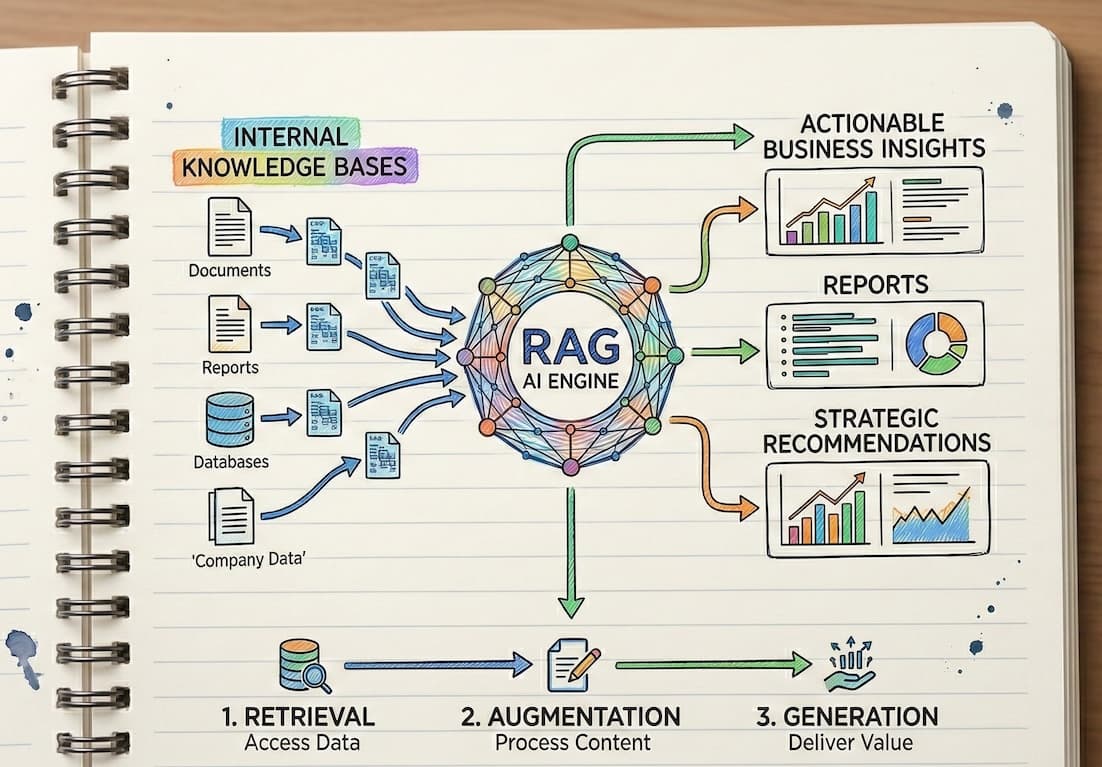
Retrieval: The system searches through your company's private documents, databases, and files to find the exact information relevant to the user's question.
Augmented: The system takes the question and pairs it with the factual information it just retrieved.
Generation: The AI model reads this specific information and generates a helpful, accurate, and conversational answer based only on the facts provided.
The Librarian Analogy
Imagine you walk into a massive library and ask the librarian, "What is the standard operating procedure for handling a broken server in our Dallas data center?"
Without RAG: The librarian tries to guess the answer based on general knowledge they learned about servers years ago. (Result: Inaccurate or generic advice).
With RAG: The librarian says, "Hold on." They run to the back, find your company's specific IT manual, open it to page 42, read it, and then explain the exact steps to you. (Result: Precise, actionable, company-specific advice).
Why Business Leaders Should Care About RAG
Adopting a RAG architecture isn't just a technical upgrade; it's a strategic business decision. Here is the ROI it delivers:
Eradicates Hallucinations: Because the AI is instructed to only use the retrieved documents to answer the question, the risk of it making things up drops dramatically. You get facts, not fiction.
Keeps Your Data Secure: You don't need to upload your sensitive IP or customer data into a public AI model to use RAG. Your data stays securely in your own environment (your own "library"), and the AI simply visits it to read the relevant pages.
Massive Cost Savings: Instead of spending millions training a custom AI model, RAG allows you to use affordable, off-the-shelf AI models and simply point them at your data.
Always Up-to-Date: If your return policy changes today, you just update the document in your database. The RAG system will instantly start giving customers the new policy. A standard AI model would need to be retrained to learn the new rule.
Real-World Business Applications
How are companies actually using RAG right now?
Next-Generation Customer Support: Chatbots that can instantly resolve customer issues by looking up past purchase histories, warranty documents, and specific product manuals, returning human-like responses rather than robotic menus.
The Ultimate Employee Helpdesk: An internal AI where employees can ask, "How many days of bereavement leave do I get?" or "What is the budget approval process for software?" and get an instant, cited answer from the company intranet.
Sales Enablement: Sales reps can ask the AI to compare a competitor's new product against their own, and the RAG system pulls from internal battle cards, spec sheets, and historical win/loss data to instantly generate a personalized email pitch.
Legal & Contract Analysis: Allowing legal teams to instantly search through thousands of historical contracts to answer questions like, "Which of our vendors have a 30-day termination clause?"
The Bottom Line
Generative AI is a powerful engine, but without your company's specific data, it's an engine without fuel. RAG is the pipeline that safely and cheaply connects your proprietary knowledge to the reasoning power of modern AI.
If you want an AI that actually works for your business, RAG is where you start.
Navin Hemani
Author